
The fundamental construct of India's neighbourhood policy still needs to be what Vajpayee postulated, Manmohan Singh embraced, and Modi energised. It's just that we need to junk domestic politics and excessive religiosity, while acquiring much humility and a renewed respectfulness towards our neighbours, recommends Shekhar Gupta.

'it's not just youth in India who are left behind because of their inability to find jobs; nearly two-thirds of Indian women of working ages do not participate at all in the paid labour force.'

There were certainly qualities adhering to the Tata Group, which emanated from the persona of Ratan Tata. Most notable of these would be the low profile he maintained, which sharply contrasted the in-your-face celebrity status, celebration of wealth and pursuit of importance many of liberalised India's rich, love, notes Shyam G Menon.

'This encourages escapism through the politics and economics of nationalism, made worse by tribalism or nativism, the package accompanied inevitably by the erosion of institutional bulwarks and therefore State capture by powerful businessmen,' notes T N Ninan.

External Affairs Minister S Jaishankar on Tuesday said it was necessary to acknowledge that China will influence India's neighbouring countries, and India must not be scared of such "competitive politics".

Good intentions are best left to political parties, governments and religious establishments, suggests T C A Srinivasa-Raghavan.
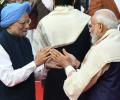
False and acrimonious debates such as Modi versus Manmohan might allow for victories that are political and partisan. But the real loser is the nation, India and Bharat, notes Arvind Subramanian, former chief economic advisor to the Modi government in its first term.

'I found it unbelievable that L&T said 45,000 jobs were waiting to be filled because of unavailability of suitable skillsets.' 'So, when the Opposition sweepingly says there are no jobs, I'm sorry... I'm not saying it's raining jobs, but there are jobs. The (skill) gap has to be bridged.'
'When manufacturing or even services cannot generate the kind of employment they are looking for, they prefer to be unemployed rather than under-employed.'

'The Opposition parties will continue to woo Chandrababu Naidu even though he has said he will support the BJP.'

The best of India's brains are instead busy solving the world's problems (I deliberately exaggerate a bit to drive home the point), as our policies incentivise them to do so.

Cheistha Kochhar, 33, was a Doctoral Candidate studying behavioural research since she moved to London from Gurugram, Haryana, last year.

'If such a practice were feasible, every state would seek additional funds, posing a significant risk to the overall health of the economy.'
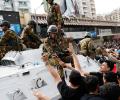
'At this moment you cannot give her asylum because if you do, then you are directing public anger against India.'

'Modi knows the people here are opposed to this project, but he is using the might of government to push this port down our throats.'

India ranks very low at 111th position in terms of economic freedom.
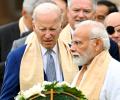
'The West has always opposed a strong nationalist leader in India and Narendra Modi is no exception.' 'The West prefers weak leaders who are amenable to Western pressure and Mr Modi's independent stance is not to the liking of the West,' asserts Colonel Anil A Athale (retd).
SBI's ownership should give confidence to depositors and lenders about the bank's solvency.

Six decades and more later, we are now captives of our identities. Every poll is based on elaborate calculations of electability of candidates on the basis of their castes and other narrow definers. That, along with voter promiscuity, is what defines our political culture, which remains stubbornly resistant to any change, asserts Shreekant Sambrani.

'I don't think we have ever seen such alignment of everything that we need in the banking sector.'

'You cannot have only one product or one market or one customer segment.'

With the last quarter of 2023-24 (FY24) expected to have been soft owing to lower discretionary spend and macro uncertainty, many are hoping FY25 will be a year of recovery for the information-technology (IT) industry. The fourth quarter, January-March, is considered soft, and will continue to see the headwinds the sector has been facing. And the sector has entered the new financial year on a weak footing. Analysts are expecting Tier-I firms to report sequential growth of -1 per cent to 1.5 per cent and midcap players' growth may range between 0.7 per cent and 4 per cent.
'We are calling companies to set up assembly plants for mobile phones while all the components are imported.' 'Only the last turn of the screwdriver is done here. And you call it self-reliance, Atmanirbharta, etc.' 'Unless you invest in research, you will not climb up the ladder. But this government is happy getting sub-contract work.'

...Even if it means less democracy, so that their everyday problems get solved? argues R Jagannathan.
Crucial reforms in Muslim personal law, especially laws related to inheritance and adoption, need to be initiated forthwith; historically speaking, without the State's backing, hardly has any reform taken place or allowed to prevail, asserts Mohammad Sajjad.

Amartya Sen was the other Presidency alumni to win the Economics Nobel. Banerjee won the 2019 Nobel Economics Prize along with two others - his wife Esther Duflo and Michael Kremer on Monday "for their experimental approach to alleviating global poverty."

'Somebody was using somebody to make statements that will stir the stock market and lead to a surge.' 'A sudden surge and a sudden crash is always an ideal situation for people to make illicit gains and then siphoning off the money.'

Ahead of the upcoming elections, political parties have started announcing incentives to benefit women, but what do women truly seek for genuine gender parity, asks Nivedita Mookerji.
'The coronavirus epidemic highlights the need to start thinking more actively about multilateral coordination, including, but not confined to, health emergencies and climate uncertainties,' says Rathin Roy.
'The assessment of most people is that there is a stable economic and political environment in India and that is attractive to investors.'

'We should not underestimate the power of Hindutva.'

There is a growing sentiment in the world and the global South in a way embodies it. But there's also political resistance, he said.

On the heels of the National Family Health Survey-5 (NFHS-5), which revealed new demographic trajectories including the replacement level of fertility, the government will, on Monday, unveil extensive economic data related to health and the broader economy. New data will relate to per capita spending on health and proportions of the GDP to health spending. Health ministry sources said the NFHS-5 marked some areas for celebration but also some markers that should cause concern.

Policymakers should aspire to restore the pre-Independence environment where the rupee was trusted and used all over South Asia, in Southeast Asia, in West Asia, and in East Africa, suggests Ajay Shah.

The banking regulator was uncomfortable with the runaway pace at which consumer credit was growing.

The new government that presents the full Budget for 2024-2025 in July should be ready to restructure the way divestment is managed and implemented, proposes A K Bhattacharya.

At this year's TIME ball in New York City on Thursday, April 25, you would have run into a Coimbatore-born American scientist, looking lovely in Sabyasachi Mukherjee designer finery, who would most likely have been hanging out with Dua Lipa.
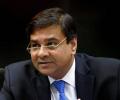
'When a soldier becomes a king, he better be a king. He should now just forget the past and move beyond continuity. He should catch the potential of India's moment and play a leader's role,' says Vallabh Bhansali of Enam Group.

In 1930, John Maynard Keynes predicted that by 2030 technology would be so advanced that three hours of work per day would suffice. Has AI brought about the transformation that Keynes predicted, asks Atanu Biswas.
 © 2026 Rediff.com - Advertise with us - Disclaimer - Privacy Policy - Sitemap - Feedback - About us - Terms of use - Grievances